Publications
Detecting Cointegrating Relations in Matrix-Valued Time Series
Economics Letters (2025) · Slides
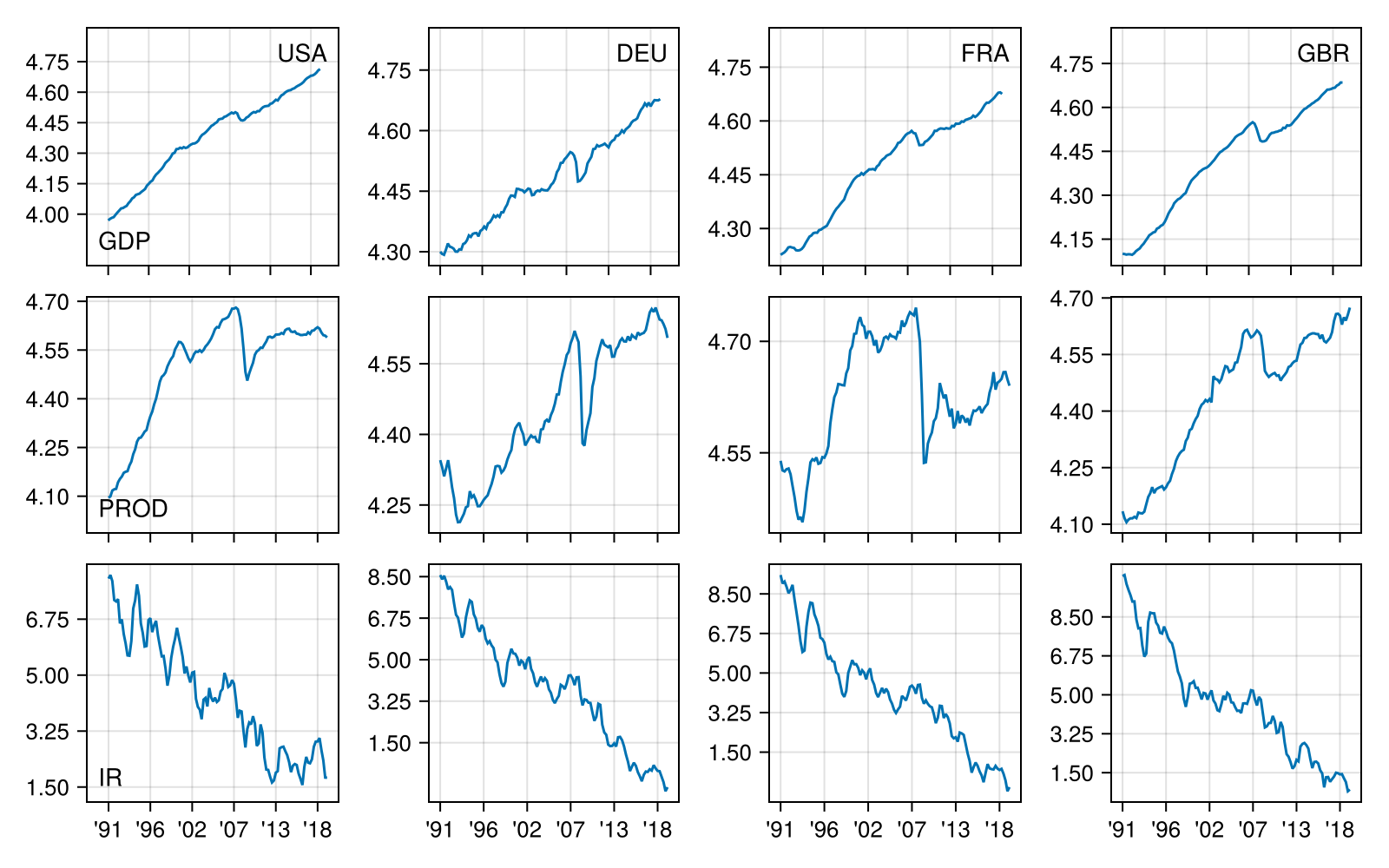
This paper proposes a Matrix Error Correction Model to identify cointegration relations in matrix-valued time series. We hereby allow separate cointegrating relations along the rows and columns of the matrix-valued time series and use information criteria to select the cointegration ranks. Through Monte Carlo simulations and a macroeconomic application, we demonstrate that our approach provides a reliable estimation of the number of cointegrating relationships.
Decomposing Co-Movements in Matrix-Valued Time Series: A Pseudo-Structural Reduced Rank Approach
Econometrics and Statistics (2026)
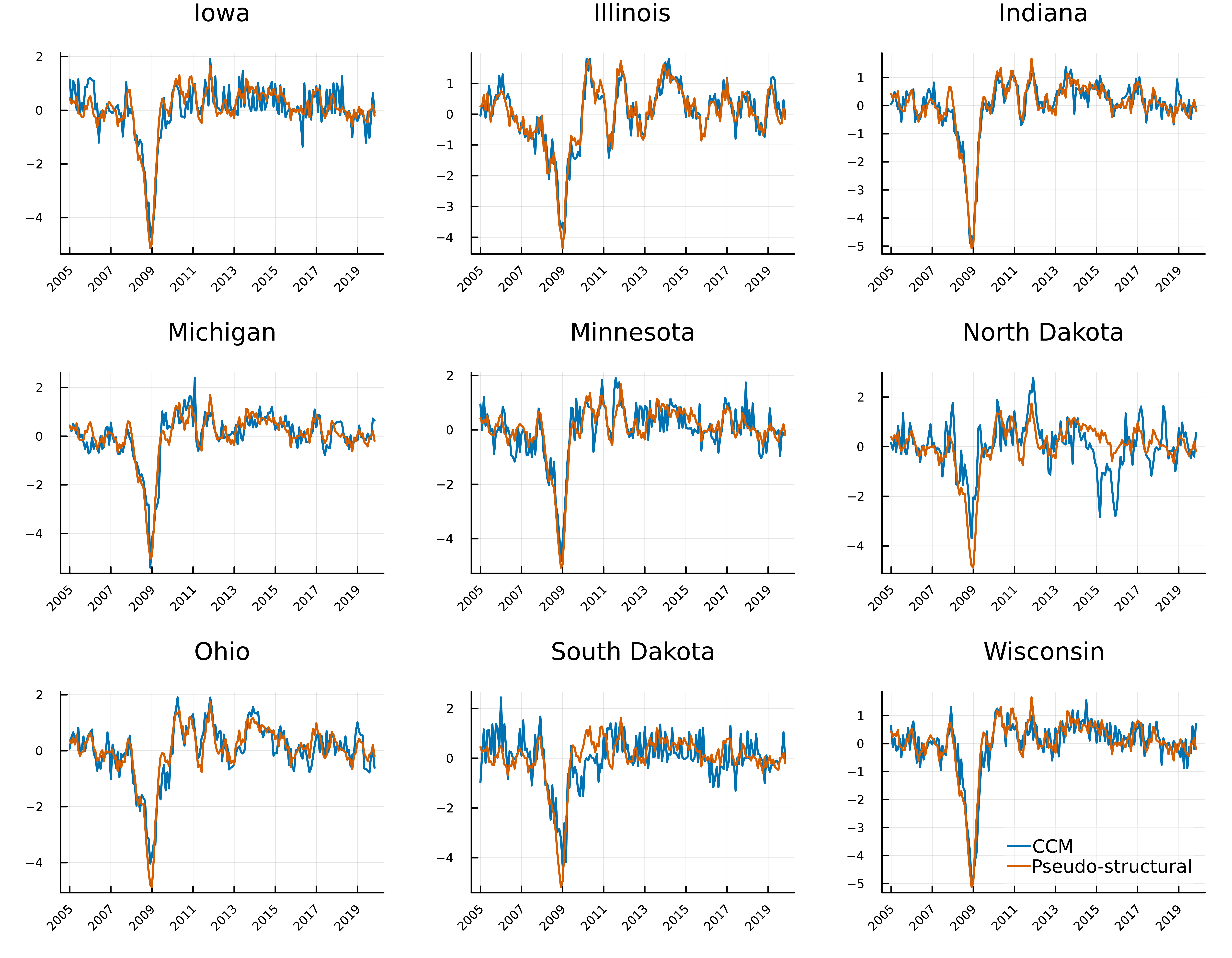
A pseudo-structural framework is proposed for analyzing contemporaneous co-movements in stationary reduced-rank matrix autoregressive (RRMAR) models. Unlike conventional vector-autoregressive (VAR) models that would discard the matrix structure, the formulation preserves it, enabling a decomposition of co-movements into three interpretable components: row-specific, column-specific, and joint (row–column) interactions across the matrix-valued time series. The estimator admits standard asymptotic inference and a BIC-type criterion is proposed for the joint selection of the reduced ranks and the autoregressive lag order. The method’s finite-sample performance in terms of estimation accuracy, coverage and rank selection is validated through simulation experiments, including cases of rank misspecification. Practical usefulness is illustrated through the application of the pseudo-structural approach to distill coincident indicators from raw labor market data across nine Midwestern U.S. states, uncovering distinct row-, column-, and joint co-movement patterns that reflect both within-state labor market dynamics and cross-state linkages.
Working Papers
Reduced-Rank Matrix Autoregressions: A Medium \(N\) Approach
arXiv:2407.07973 · Slides
Reduced-rank regressions are powerful tools used to identify co-movements within economic time series. However, this task becomes challenging when we observe matrix-valued time series, where each dimension may have a different co-movement structure. We propose reduced-rank regressions with a tensor structure for the coefficient matrix to provide new insights into co-movements within and between the dimensions of matrix-valued time series. Moreover, we relate the co-movement structures to two commonly used reduced-rank models, namely the serial correlation common feature and the index model. Two empirical applications involving U.S. states and economic indicators for the Eurozone and North American countries illustrate how our new tools identify co-movements.
Works in Progress
- Impulse Response Inference for Matrix-Valued Time Series